A friend sent me a great meme yesterday –

He framed it as some pushback from GenZ about the upcoming mobile phone ban in schools.
Last year, my kids’ (government) school implemented a mobile phone ban with the use of Yondr pouches. Beforehand, the school asked for parent feedback, which I thought was a great thing. What worried me most was the framing of the problem: the school leadership team said that there was very little research on the effect of mobile phones in schools, and the efficacy of bans, and then cited three publications on which they were basing their approach.
Having done research on the use of mobile devices in BYOD programs for music (heck, we even made a website on it to help teachers during lockdown!), this didn’t sound right to me. I knew that there was, if anything, the opposite problem – so much research, that it was hard to make any kind of simple decision that was informed by it.
I’m lucky enough to teach this stuff in one of my courses at the University of Sydney, so I decided to give up a day to reading literature, and update my lecture at the same time. While one day isn’t long enough (by far!) to do a systematic literature review, it was certainly enough time to take a temperature check. You can read the review and my conclusions below, but on the meme above, and the current situation, I would like to say that I took two lessons away from this experience.

First, that it’s all well and good to claim that your decisions are research-backed or evidence-based if they are, but lazily finding three papers that back up your position is actually really bad educational modelling for children and young people, especially when you’re actually misrepresenting the field in the first place. Teachers can’t be over all of the research, which is why in most countries that take Evidence-Based or Evidence-Informed Practice seriously, there are independent research centres to help summarise the research, which can then inform (rather than direct) practice. We don’t have this in Australia, sadly – our governments have created pretend research organisations as part of government departments (CESE here in NSW, AERO nationally) which are not independent, so this may have contributed to this kind of poor practice.
Second, while (as you’ll see below), I think there are good reasons to restrict phones just as there are good reasons to have them available, this is not a school problem, this is a societal problem. Parents are very quick to ask for bans of devices they’ve given their children, and to which they give pretty open access in the home. On top of decades of research about kids’ access (via parents) to screen-based entertainment from a very young age, there seems to be a pretty important abdigation of parental responsibility here. Perhaps schools shouldn’t just be asking parents what they want at school, but asking them how they’re dealing with this at home, and then extending approaches into the classroom, with lots of discussion around healthy use of technology (which, in my not-so humble opinion, is much more useful than banning things).
Here’s the work I did…
Short literature review: the use of mobile phones in high school education
Introduction
In mid-2022, a high school close to where I live was in the national press for a “mobile phone ban”. It used a commercially-available system that required students to lock their phone in a pouch at the start of the school day, and release it at the end. In class time, teachers could unlock phones if they wanted them to be used for learning: it would probably therefore be better described as restricted mobile phone use than a complete “ban”. The article reported this story in mostly positive terms.
At this time, my son was in his first year of high school at another local school. The newspaper article was widely shared by parents who, in social media groups, suggested petitioning their own school to adopt the system, or something like it. While I have always taken a critical approach to the use of technology in education (2020), the calls from parents to immediately ban phones at another school felt reactionary, and inconsistent with the literature I’d read. Therefore, I undertook a short but more up-to-date review of the literature to share with parents. The Discussion section after the Literature Review is very much aimed at parent-readers.
This is initial work, shared here not as a publishable output, but as a jumping-off point for other scholars or even parents interested in helping their school communities make evidence-based decisions about the use of mobile phones in high schools.
Method
While a Systematic Review would be ideal in this situation, the current aim was to sample the most cited, and the most recent literature on the broad topic of the use of use of mobile phones in high school education (including the non-use i.e. banning). The corpus did not include related topics such as social media use and young people’s well-being, device or game addition, or broader pedagogical questions such as how policy, politics, and society might interact, although these issues are discussed directly in the mobile phone literature and so are mentioned in this context here.
Scopus (access through the University of Sydney) and Google Scholar (access is public) databases were used to search for the terms “mobile phones” classroom school, for systematic literature review mobile phones learning school (in an attempt to capture any fuller reviews than mine that may have already covered this territory), and for ban mobile phones schools. All three searches were repeated replacing “mobile” with “cell” for the US vernacular, but this did not reveal many unique results.

Because of the fast-moving nature of technological and societal change, in the most cited search results, academic papers and book chapters were excluded if they were over 10 years old. In the most recent literature, papers about the use of mobile phones and m-learning specifically during the pandemic were also excluded, since they focus on lockdown and remote learning, rather than the everyday school/classroom experience. I manually excluded papers about the primary and tertiary education levels unless, again, they offered something valuable to the topic in question (for example, one paper on the age students receive mobile phone access investigated the subsequent developmental impacts during adolescence).
To cover as much literature as possible in a short review, Abstracts-only were reviewed and placed into thematic groups. Because most papers were summarised and categorised at the abstract level, nuance is missing from the following analysis (although, plenty of nuance is developed through comparison of high-level findings). A lot of papers were on teacher perceptions of mobile use, with fewer about student or parent perception. I have tried to describe and compare these distinctly from experimental papers. There is a good range of qualitative and quantitative research.
It is worth noting that there is a difference between m-learning (mobile-learning) and the specific use of mobile phones as m-learning devices. M-learning includes the use of tablet devices (such as iPads or Android tablets), and lightweight laptops in addition to mobile phones, and frequently shows up in these corpus searches. I ignored papers about m-learning unless they specifically mentioned mobile phones. Incidentally, we reviewed the m-learning literature in a 2016 paper about the use of BYOD in music education (J. H. B. Humberstone & Ly, 2016). We noted that “The existing research on the use of new mobile devices in education […] is overwhelmingly positive on the successful engagement of students, achievement of students, change in teaching strategies and enhanced collaboration between students (Bebell & O’Dwyer, 2010). It makes grand claims, from the improvement of reading skills in students with ADHD (McClanahan et al., 2012), to increased mathematics assessment scores in primary school students (Kiger et al., 2012; McKenna, 2012), higher demand for iPads over other tablets and eReaders (Zijian & Wallace, 2012), increased motivation to learn independently (Kinash et al., 2012) and improvements in the teaching experience (Shepherd & Reeves, 2011)”. However, we also criticised the literature for being so one-sided. The following review is much less one-sided, reflecting a huge shift and diversification in/of studies over the last decade.
The review is presented within the arising themes, formulated as described above.
Short Literature Review
Broad positive findings about allowing students to use mobile phones in high school
A Systematic Review of 60 articles (the biggest found in this field) published between 2011 and 2022 (Calderón-Garrido et al., 2022) concluded that “scientific production would seem to back the introduction of mobile phones in classrooms as beneficial for educational purposes provided that certain preliminary work is carried out and a certain development is achieved of the digital and media skills of both students and teaching staff” (p. 194).
In the biggest study, population-wise, in this field, Gómez-Garcia et al. (2020) analysed “1,887,027 students from 7,381 compulsory secondary education schools in Spain” (p. 1) and compared the academic performance of schools that allowed mobile phone use with those that did not. They found that there was a “a strong correlation between centers and territories that allow the usage of mobile devices in education and academic performance” (p. 1). It is worth noting, however, that there is research also from Spain that contradicts these findings (Beneito & Vicente-Chirivella, 2022).
Mobile phones have been shown to have a positive impact in developing and developed countries, especially in terms of improving access to education. Studies in Philippines, Mongolia, Thailand, India, and Bangladesh (Pandey & Singh, 2015; Valk et al., 2010) point to a number of benefits of allowing mobile phone use in schools. In India, mobile phone use was shown to bridge the connection between school and home, advancing digital equity by reaching children from economically disadvantaged communities, and as an aid for formal and informal learning, thus holding the potential “to transform the delivery of education and training” (Pandey & Singh, 2015, p. 107).

Sweden seems to be well ahead of the rest of the world in having had begun this debate over a decade ago. In one Swedish study, 56% of students stated that they used their mobile phone for school work, and that they were able to perceive when the mobile device was suitable for a task, and when it was not (Ott et al., 2014). In another, students were shown to be capable of “balancing their mobile phone usage with the teachers’ arbitrary enforcement of policy” (Ott et al., 2018, p. 517). However, the news from Sweden isn’t all good: “Adolescents attending schools with health policies, mobile phone bans and more time for PE showed higher levels of physical activity and lower sedentary time” (Nyberg et al., 2021, p. 1).
There are a number of narrower but nonetheless positive impacts that have been found by allowing mobile phone use in school classrooms: Specialist mobile phone apps can help children and young people with special learning needs such as Autism Spectrum Disorder (ASD) (Leung et al., 2021); Social media running on student phones can be used to enhance learning (Valasmo et al., 2022); Mobile phone apps can improve critical thinking (Sinaga et al., 2022).
Broad negative findings about allowing students to use mobile phones in high school
Although it may be a contested area, there are peer-reviewed papers identifying the presence of mobile phone addiction in children (6.5%) and adolescents (16%) (Sahu et al., 2019).
A systematic review of 23 publications on smartphone use and academic success (Amez & Baert, 2020) found “a predominance of empirical results supporting a negative association between students’ frequency of smartphone use and their academic success” (p. 1), directly contradicting the (larger) study cited above (Calderón-Garrido et al., 2022). An earlier publication (Beland & Murphy, 2016) based on analysis of student data in 4 schools in the UK found that “student performance in high stakes exams significantly increases post [mobile phone] ban, by about 0.07 standard deviations on average” (p. 61). However, a replication of this study in Sweden found no impact of mobile phone on student performance (Kessel et al., 2020).
As mentioned above, in Spain, one region banned mobile phones, while another did not: analysis showed less bullying and better academic (PISA) results in the region that banned mobile phones (Beneito & Vicente-Chirivella, 2022).
While Kopecky et al. (2021) do not, in their findings, support mobile phone bans (see below for more details), they did find that young people (n = 21,177) who had access to mobile phones during breaks at school “preferred to use them, instead of practicing sports or social activities” (p. 1). This Figure summarises the differences well:
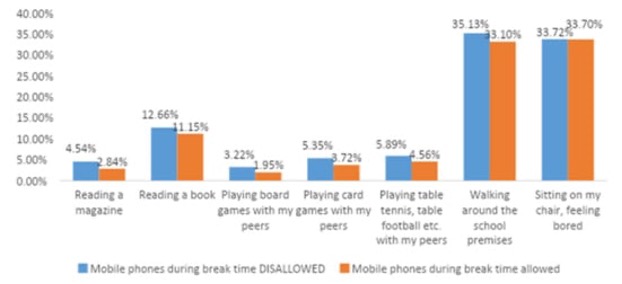
Figure from Kopecký, Kamil, Francisco-Domingo Fernández-Martín, René Szotkowski, Gerardo Gómez-García, and Klára Mikulcová. “Behaviour of Children and Adolescents and the Use of Mobile Phones in Primary Schools in the Czech Republic.” International Journal of Environmental Research and Public Health 18, no. 16 (January 2021): 8352. https://doi.org/10.3390/ijerph18168352.
Although it does not match the secondary school target of this short review, it is worth mentioning Dempsey et al.’s (2019) striking study, based on a large Irish population, of the impact of the age of first mobile phone ownership on children’s later development, specifically that in the “reading and maths domains, children who already report owning a phone by the age of nine fare less well in terms of their academic development as they move into adolescence” (p. 798). A further study suggested that this specifically affects girls (Dempsey et al., 2020). The authors emphasise the family/social context (see also Xie et al., 2019): parents are responsible for giving children mobile phones, for modelling their use, and setting rules around how they can be used.
We need to find a balance between banning phones and allowing open slather
As mentioned above, Kopecky et al (2021) found that students who had access to their mobile phones during break times, socialised and practiced sports less. However, this did not lead them to conclude that phones should be banned or even restricted, instead suggesting that schools should implement policies that encourage healthy activities. They also reported that a mobile phone ban “encourages students to use them secretly and increases their desire to use them” (p. 1). They advocate for the educational use of mobile phones “promoting collaborative learning and increasing student motivation” (p. 1). In addition, another Systematic Literature Review mentioned above found that while the scientific evidence points toward the adoption of mobile phones in classrooms, it was not without caveats (Calderón-Garrido et al., 2022): a balance has to be struck.
Other studies point to both benefits and challenges of allowing mobile phones in secondary schools, but conclude that overall it is better to carefully allow the use of phones than to ban them (Karch, 2014; Ott, 2017).
Recommendations for finding the balance have been made and can be followed by schools/districts making decisions (Rhoades, 2021; Smale et al., 2021; Thomas et al., 2013; Tricoli, 2022).
Teachers’ perceptions of allowing mobile phones in classrooms
It seems that teachers have widely varying perceptions of whether mobile phones have a positive or negative impact on learning in their classrooms. The results of studies seem to depend on location, culture, and societal values.

Teachers who are over 50 years old are much less likely to own smartphones, and much less likely to support the use of mobile phones in education than younger teachers (O’Bannon & Thomas, 2014). In fact, contrary to popular belief, the majority of teachers (69%, n=79) support their use because they identify benefits to student engagement and motivation, despite also recognising problems with lack of access and class disruption (Thomas et al., 2013). One study in a private school in India found that an even higher proportion–86% of teachers — supported the use of mobile phones in the classroom (O’Bannon et al., 2017). But another in Kentucky and Tennessee (Thomas et al., 2014) found that “slightly more teachers did not support the use of mobile phones in the classroom than those who did support their use” (p. 373).
In Greece, teachers perceived better motivation, engagement, participation, enjoyment, and access to information when students used their mobile phones in class, but were concerned about abusive behaviour, noise-disruption, and distraction (Nikolopoulou, 2020).
In addition, there are classroom management strategies that can be applied to reduce the inappropriate use of mobile phones via the “Good Behaviour Game” that also increase academic engagement (Hernan et al., 2018; see also the papers cited that make recommendations, above).
Behaviour and mobile phone use
Beeri & Horowitz (2020) studied the relationship between discipline and self-distractive use of mobile phones. Perhaps surprisingly, they found that the permissive style of discipline (Baumrind, 1991; Pellerin, 2005) was the most effective at reducing self-distraction, while a more authoritative discipline contributed to high self-distractive phone use. Other suggestions have been made about classroom management and the use of mobile phones post-pandemic, in the context that students have become used to having phones with them while they learn (Tricoli, 2022).
In addition, and as mentioned above, some (but not all) studies link mobile phone use at school with bullying (Beneito & Vicente-Chirivella, 2022).
Improving relationships and extending learning beyond the classroom
Nowell (2014) found that teachers and students use social media and mobile phones as “as learning and relationship building tools, inside and outside the classroom” (p. 109). While students found it difficult to explain how these tools improved their learning, teachers articulated that they could extend learning beyond the classroom and improve relationships.
Criticisms of contemporary discourse around mobile phone use in schools
Selwyn & Aagaard (2021) criticise politicians (including several Australian politicians) and the popular press for simplistic and inaccurate assumptions about technology “addiction,” distraction and cyberbullying. They provide more nuanced understandings of these issues, but also offer an optimistic approach to the popularity of phone bans “as an opportunity for developing students’ digital understandings and awareness” (p. 9).
Discussion
The only way to make a single recommendation for the complete ban of mobile phones in high schools such as my son’s, whether as a recommendation for or against, is to ignore a good proportion of the literature. Instead, any recommendation made, and the resulting decision, should be nuanced, and weigh the pros and cons of any approach.
This review has uncovered more research that reveals positive aspects of allowing students some use of mobile phones in high schools. However, it may be that the search terms or search engines used influenced the resulting literature reviewed. Again, it is probably more useful to discuss the nuances than the absolutes.
On balance, the review suggests that the NSW Department of Education’s policy statement on Student use of digital devices and online services (NSW Government, 2021) is world-class. While this review did not focus on the provision of mobile phones in primary schools, the findings discussed above about the negative developmental implications of giving smartphones to children as young as 9 years old (Dempsey et al., 2019, 2020) meet with prior reviews I have undertaken on screen-based technology and child development (2020) – to cite Dempsey et al., “later is better”.

At the same time, the Department’s policy gives high school communities the autonomy to approach the use of mobile phones (and other digital devices) their own way. Given the difference shown above in negative and positive results from allowing or banning mobile phone use from country to country and even region to region, the evidence suggests that leaving this decision to school communities instead of making a top-down “one size fits all” ruling is the most appropriate position to take.
Two final points are worth making to contribute to robust discussion in my local school community. First, while the discussion in the popular media is “to ban or not to ban”, the research reviewed offers many alternatives that allow students to use mobile phones in ways that the school has decided are appropriate and beneficial, and limit their use at other times. In fact, it should be noted that the high school approach reported in the press allows teachers to unlock phones for use in class time where the individual teacher deems it appropriate – it is not actually an absolute phone ban. Maintaining teacher and school autonomy allows students to benefit in more ways than insisting that the decision must be a simplistic dichotomy. In addition, restrictions that do provide more freedom than the “pouches” option, or equivalent, would give students an opportunity to learn self-control around device use in a safe and supportive environment.
Second, while the role of the family seems to be central to the literature around primary students’ access to and use of mobile phones, it seems to be strangely missing from the above literature (and perhaps the popular discussion?). In some communities there is a strong call from parents to ban the very mobile phones that they have given their own children (and, presumably, given their own children permission to take to school, install apps they’re tempted to use, and so on). None of the research reviewed is asking why, if they feel so strongly about this subject, parents aren’t limiting their children’s access to mobile phones in schools. Further research and discussion around the role of the family in respect to both the positive and negative impacts of mobile phones in and out of school may lead to a much more sophisticated discussion and solutions; perhaps solutions that are more responsive to the culture(s) and society in which the young people are growing up and participating as they move toward adulthood.
References
Amez, S., & Baert, S. (2020). Smartphone use and academic performance: A literature review. International Journal of Educational Research, 103, 101618. https://doi.org/10.1016/j.ijer.2020.101618
Bebell, D., & O’Dwyer, L. (2010). Educational Outcomes and Research from 1:1 Computing Settings. The Journal of Technology, Learning and Assessment, 9(1), 16–16.
Beeri, I., & Horowitz, D. D. (2020). Reducing students’ ‘absent presenteeism’ and mobile misbehaviour in class: An empirical study of teacher perspectives and practices. Technology, Pedagogy and Education. http://www.tandfonline.com/doi/abs/10.1080/1475939X.2020.1731580
Beland, L.-P., & Murphy, R. (2016). Ill Communication: Technology, distraction & student performance. Labour Economics, 41, 61–76. https://doi.org/10.1016/j.labeco.2016.04.004
Beneito, P., & Vicente-Chirivella, Ó. (2022). Banning mobile phones in schools: Evidence from regional-level policies in Spain. Applied Economic Analysis, ahead-of-print(ahead-of-print). https://doi.org/10.1108/AEA-05-2021-0112
Calderón-Garrido, D., Ramos-Pardo, F. J., & Suárez-Guerrero, C. (2022). The Use of Mobile Phones in Classrooms: A Systematic Review. International Journal of Emerging Technologies in Learning (IJET), 17(6). https://papers.ssrn.com/abstract=4069498
Dempsey, S., Lyons, S., & McCoy, S. (2019). Later is better: Mobile phone ownership and child academic development, evidence from a longitudinal study. Economics of Innovation and New Technology, 28(8), 798–815. https://doi.org/10.1080/10438599.2018.1559786
Dempsey, S., Lyons, S., & McCoy, S. (2020). Early mobile phone ownership: Influencing the wellbeing of girls and boys in Ireland? Journal of Children and Media, 14(4), 492–509. https://doi.org/10.1080/17482798.2020.1725902
Gómez-García, M., Soto-Varela, R., Morón-Marchena, J. A., & del Pino-Espejo, M. J. (2020). Using Mobile Devices for Educational Purposes in Compulsory Secondary Education to Improve Student’s Learning Achievements. Sustainability, 12(9), 3724. https://doi.org/10.3390/su12093724
Hernan, C. J., Morrison, J. Q., Collins, T. A., & Kroeger, S. D. (2018). Decreasing Inappropriate Mobile Device Use in Middle and High School Classrooms. Intervention in School and Clinic, 54(1), 47–51. https://doi.org/10.1177/1053451218762498
Humberstone, J. H. B. (2020). Music Learning and Screen Time; The Right Age for Screen Time. Lectures 19 & 20 from The Place of Music in 21st Century Education MOOC. https://doi.org/10.13140/RG.2.2.25150.64328
Humberstone, J. H. B., & Ly, R. (2016). Content analysis of software for Bring Your Own Device (BYOD) programs in Music Education. 32nd ISME World Conference on Music Education.
Karch, K. (2014). An investigation of perceptions about smart mobile phone usage as an instructional tool in a high school classroom [Ph.D., Capella University]. In ProQuest Dissertations and Theses. https://www.proquest.com/docview/1540789099/abstract/28BBEDFE57344089PQ/1
Kessel, D., Hardardottir, H. L., & Tyrefors, B. (2020). The impact of banning mobile phones in Swedish secondary schools. Economics of Education Review, 77, 102009. https://doi.org/10.1016/j.econedurev.2020.102009
Kiger, D., Herro, D., & Prunty, D. (2012). Examining the Influence of a Mobile Learning Intervention on Third Grade Math Achievement. Journal of Research on Technology in Education, 45(1), 61–82.
Kinash, S., Brand, J., & Mathew, T. (2012). Challenging mobile learning discourse through research: Student perceptions of Blackboard Mobile Learn and iPads. Australasian Journal of Educational Technology, 28(4), 16–16.
Kopecký, K., Fernández-Martín, F.-D., Szotkowski, R., Gómez-García, G., & Mikulcová, K. (2021). Behaviour of Children and Adolescents and the Use of Mobile Phones in Primary Schools in the Czech Republic. International Journal of Environmental Research and Public Health, 18(16), 8352. https://doi.org/10.3390/ijerph18168352
Leung, P. W. S., Li, S. X., Tsang, C. S. O., Chow, B. L. C., & Wong, W. C. W. (2021). Effectiveness of Using Mobile Technology to Improve Cognitive and Social Skills Among Individuals With Autism Spectrum Disorder: Systematic Literature Review. JMIR Mental Health, 8(9), e20892. https://doi.org/10.2196/20892
McClanahan, B., Williams, K., Kennedy, E., & Tate, S. (2012). A Breakthrough for Josh: How Use of an iPad Facilitated Reading Improvement. TechTrends, 56(3), 20–28. https://doi.org/10.1007/s11528-012-0572-6
McKenna, C. (2012). There’s an App for That: How Two Elementary Classrooms Used iPads to Enhance Student Learning and Achievement. Education, 2(5), 7–7. https://doi.org/10.5923/j.edu.20120205.05
Nikolopoulou, K. (2020). Secondary education teachers’ perceptions of mobile phone and tablet use in classrooms: Benefits, constraints and concerns. Journal of Computers in Education, 7(2), 257–275. https://doi.org/10.1007/s40692-020-00156-7
Nowell, S. D. (2014). Using disruptive technologies to make digital connections: Stories of media use and digital literacy in secondary classrooms. Educational Media International, 51(2), 109–123. https://doi.org/10.1080/09523987.2014.924661
NSW Government. (2021, November 2). Student use of digital devices and online services. NSW Department of Education. https://education.nsw.gov.au/policy-library/policies/pd-2020-0471.html
Nyberg, G., Ekblom, Ö., Kjellenberg, K., Wang, R., Larsson, H., Thedin Jakobsson, B., & Helgadóttir, B. (2021). Associations between the School Environment and Physical Activity Pattern during School Time in Swedish Adolescents. International Journal of Environmental Research and Public Health, 18(19), 10239. https://doi.org/10.3390/ijerph181910239
O’Bannon, B. W., & Thomas, K. (2014). Teacher perceptions of using mobile phones in the classroom: Age matters! Computers & Education, 74, 15–25. https://doi.org/10.1016/j.compedu.2014.01.006
O’Bannon, B. W., Waters, S., Lubke, J., Cady, J., & Rearden, K. (2017). Teachers and Students Poised to Use Mobile Phones in the Classroom. Computers in the Schools, 34(3), 125–141. https://doi.org/10.1080/07380569.2017.1347454
Ott, T. (2017). Mobile phones in school: From disturbing objects to infrastructure for learning. https://gupea.ub.gu.se/handle/2077/53361
Ott, T., Haglind, T., & Lindström, B. (2014). Students’ Use of Mobile Phones for School Work. In M. Kalz, Y. Bayyurt, & M. Specht (Eds.), Mobile as a Mainstream – Towards Future Challenges in Mobile Learning (pp. 69–80). Springer International Publishing. https://doi.org/10.1007/978-3-319-13416-1_8
Ott, T., Magnusson, A. G., Weilenmann, A., & Hård af Segerstad, Y. (2018). “It must not disturb, it’s as simple as that”: Students’ voices on mobile phones in the infrastructure for learning in Swedish upper secondary school. Education and Information Technologies, 23(1), 517–536. https://doi.org/10.1007/s10639-017-9615-0
Pandey, K., & Singh, N. (2015). Mobile Learning: Critical Pedagogy to Education for All. In Y. (Aimee) Zhang (Ed.), Handbook of Mobile Teaching and Learning (pp. 107–132). Springer. https://doi.org/10.1007/978-3-642-54146-9_6
Rhoades, G. H. (2021). Decriminalizing Cell Phones: Before and After the Pandemic [Chapter]. Affordances and Constraints of Mobile Phone Use in English Language Arts Classrooms; IGI Global. https://doi.org/10.4018/978-1-7998-5805-8.ch005
Sahu, M., Gandhi, S., & Sharma, M. K. (2019). Mobile Phone Addiction Among Children and Adolescents: A Systematic Review. Journal of Addictions Nursing, 30(4), 261–268. https://doi.org/10.1097/JAN.0000000000000309
Selwyn, N., & Aagaard, J. (2021). Banning mobile phones from classrooms—An opportunity to advance understandings of technology addiction, distraction and cyberbullying. British Journal of Educational Technology, 52(1), 8–19. https://doi.org/10.1111/bjet.12943
Shepherd, I. J., & Reeves, B. (2011). iPad or iPad—The reality of a paperless classroom. Abilene Christian University Mobility Conference, 26–26.
Sinaga, P., Setiawan, W., & liana, M. (2022). The Impact of Electronic Interactive Teaching Materials (EITMs) in E-Learning on Junior High School Students’ Critical Thinking Skills. Thinking Skills and Creativity, 101066. https://doi.org/10.1016/j.tsc.2022.101066
Smale, W. T., Hutcheson, R., & Russo, C. J. (2021). Cell Phones, Student Rights, and School Safety: Finding the Right Balance. Canadian Journal of Educational Administration and Policy / Revue Canadienne En Administration et Politique de l’éducation, 195, 49–64. https://doi.org/10.7202/1075672ar
Thomas, K. M., O’Bannon, B. W., & Bolton, N. (2013). Cell Phones in the Classroom: Teachers’ Perspectives of Inclusion, Benefits, and Barriers. Computers in the Schools, 30(4), 295–308. https://doi.org/10.1080/07380569.2013.844637
Thomas, K. M., O’Bannon, B. W., & Britt, V. G. (2014). Standing in the Schoolhouse Door: Teacher Perceptions of Mobile Phones in the Classroom. Journal of Research on Technology in Education, 46(4), 373–395. https://doi.org/10.1080/15391523.2014.925686
Tricoli, M. (2022). Teacher Perceptions of Cell Phone Use during the Instructional School Day [Ed.D., St. John’s University (New York)]. In ProQuest Dissertations and Theses. https://www.proquest.com/docview/2689199188/abstract/FEFF7A2D073B40BBPQ/1
Valasmo, V., Paakkari, A., & Sahlström, F. (2022). The device on the desk – a sociomaterial analysis of how Snapchat adapts to and participates in the classroom. Learning, Media and Technology, 0(0), 1–15. https://doi.org/10.1080/17439884.2022.2067176
Valk, J.-H., Rashid, A. T., & Elder, L. (2010). Using Mobile Phones to Improve Educational Outcomes: An Analysis of Evidence from Asia. International Review of Research in Open and Distributed Learning, 11(1), 117–140. https://doi.org/10.19173/irrodl.v11i1.794
Xie, X., Chen, W., Zhu, X., & He, D. (2019). Parents’ phubbing increases Adolescents’ Mobile phone addiction: Roles of parent-child attachment, deviant peers, and gender. Children and Youth Services Review, 105, 104426. https://doi.org/10.1016/j.childyouth.2019.104426
Zijian, G., & Wallace, J. D. (2012). A Comparative Analysis of iPad and Other M-learning Technologies: Exploring Students’ View of Adoption, Potentials, and Challenges. Journal of Literacy and Technology, 13(1), 28–28.
